
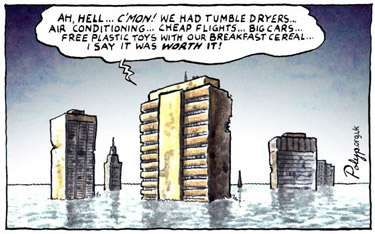
Imagining a nation free of fossil fuel investment

polyp.org.uk - New Internationalist magazine cartoonist

polyp.org.uk – New Internationalist magazine cartoonist

It’s simple really. If you want good things to happen, invest in them. If you want to stop bad things happening, cut off their funding.

But that’s not yet occurring. Banks, super-funds and governments keep investing in activities that we know are rapidly destroying the life-support systems of our planet, and it must stop.

That’s why the Bill McKibben Tour this week is so powerful and so important. Bill is a passionate advocate for divestment – getting out of investments in fossil fuels – and his presentations are clear and memorable. If you know a banker, a superannuation fund employee or a government worker, invite them to join you at one of the events on the Bill McKibben Do the Maths roadshow. You can book now for live events in Canberra – June 5th (with internet simulcasts to Adelaide, Hobart and Perth), Canberra National Press Club – June 6th, Melbourne – June 7th and Brisbane – June 9th.
Continue reading →

Divestment from fossil fuels

do_the_math_logoan open letter to the CEO of the ANZ Bank

For Personal Attention: Mike Smith, CEO

Dear Mike,

I figure you’re a decent chap. You’re quoted as saying: “We are focussed on growing our business responsibly, managing risks rather than taking them and approach our role in society with a heightened sense of duty and care towards our customers and the communities we serve.”

You’ve achieved that on one level. Your branch staff are some of the most efficient, knowledgeable, helpful and best-trained workers I’ve come across in retail banking. Well done.

But there’s a serious problem with ANZ activities on the national and international level. Consider these two questions:

  • Would you say it’s wrong to do things that are seriously harmful to the planet’s ecosystem?
  • Would you say it’s wrong to profit financially from doing things that are seriously harmful to the planet’s ecosystem?

So that’s the issue. Is it true that ANZ Bank continues to invest in fossil fuel exploration and extraction? Is it true that ANZ Bank and its investors continue to make profits from destroying the planet’s ecosystem?

Continue reading →

The city can save the planet

The facilitator asked us to do some dream-work.  That’s normally not so hard, but there we were, standing in an awkward-shaped T-allotment strewn with bits of broken glass and featuring some derelict out-buildings.  The site had previously been a city recycling depot and in a way one of our goals was to continue that recycling heritage.  We were asked to dream of what the features would be for our ideal sustainable-living community on the site.  It all seemed pretty much pie-in-the-sky, but the suggestions rolled in.  We wanted a green community, comfortable for the residents but kind to the environment; something that would significantly cut our environmental footprint.  We wanted a working alternative to urban sprawl.  We wanted to help heal the web of life by bringing biodiversity back into the city.  And we wanted it to be a community, not just a collection of disconnected dwellings.

Continue reading →

A New Year resolution

Here’s a big thank you to the team from the Department of Climate Change and Energy Efficiency who rounded off a solid year of tortuous negotiations with some progress at COP18 in Doha. Of course we’re disappointed that there’s such slow global action on the climate crisis that is unfolding, but we should still celebrate the huge effort being put in by Climate Change staff.

The tough reality is that within two decades we need to stop burning coal, gas and oil. We simply cannot accept the 4 to 6 degree temperature rise that is likely by the end of the century if we don’t move to a zero-emissions economy. But moving to zero-emissions won’t happen for as long as governments and international negotiations are in thrall to the fossil fuel industry.
Continue reading →

Rally for solar

Clouds are never a good look at rallies for renewable energy. Nor is a light but constant drizzle, or the sight of a big, dirty old truck being used for a stage. Climate change activists are used to these minor ironies. They are also used – though not resigned – to continuing government inaction on an issue which enjoys massive public support for change as well as a near-complete scientific consensus.

All of these things – activists, government, a big truck, an energised public and, yes, appalling weather – came together on September 30th in Adelaide’s Rundle Park for a heartening intervention in the fight for more action on that moral challenge.
Continue reading →

Building Australia’s first solar thermal power plant

“They told us we wouldn’t get here, there were those who said we would only get here over their dead bodies. All the world today knows that we are here and we are standing before the forces of power in Alabama saying ‘We ain’t gonna let nobody turn us around!’” – Martin Luther King Jr, Selma to Montgomery, March 1965.

I will never know the names of the people who marched from Selma to Montgomery with Dr King and chances are you won’t either.  Nor are you likely to know the names of the people who walked with Gandhi on the Salt March, yet our history and imaginations are caught by the thought of hundreds of ordinary people going to (and walking for) extraordinary lengths to fight for justice.  No matter what came, nothing would move these people, and nobody could turn them around.

These walks have often been taken and led by people on the margins, whether on the wrong side of segregation or an invasion, people who were willing to do whatever it took to achieve freedom.

This year a small city in rural South Australia has captured the attention and imagination of the climate movement.  This place is called Port Augusta.  Home to two dirty coal fired power stations facing closure, you wouldn’t be wrong in saying that the town’s future is uncertain.  However, out of this uncertainty the Port Augusta community has found hope and started to organise and write its own future.
Continue reading →